
The numbers
Understanding length + girth
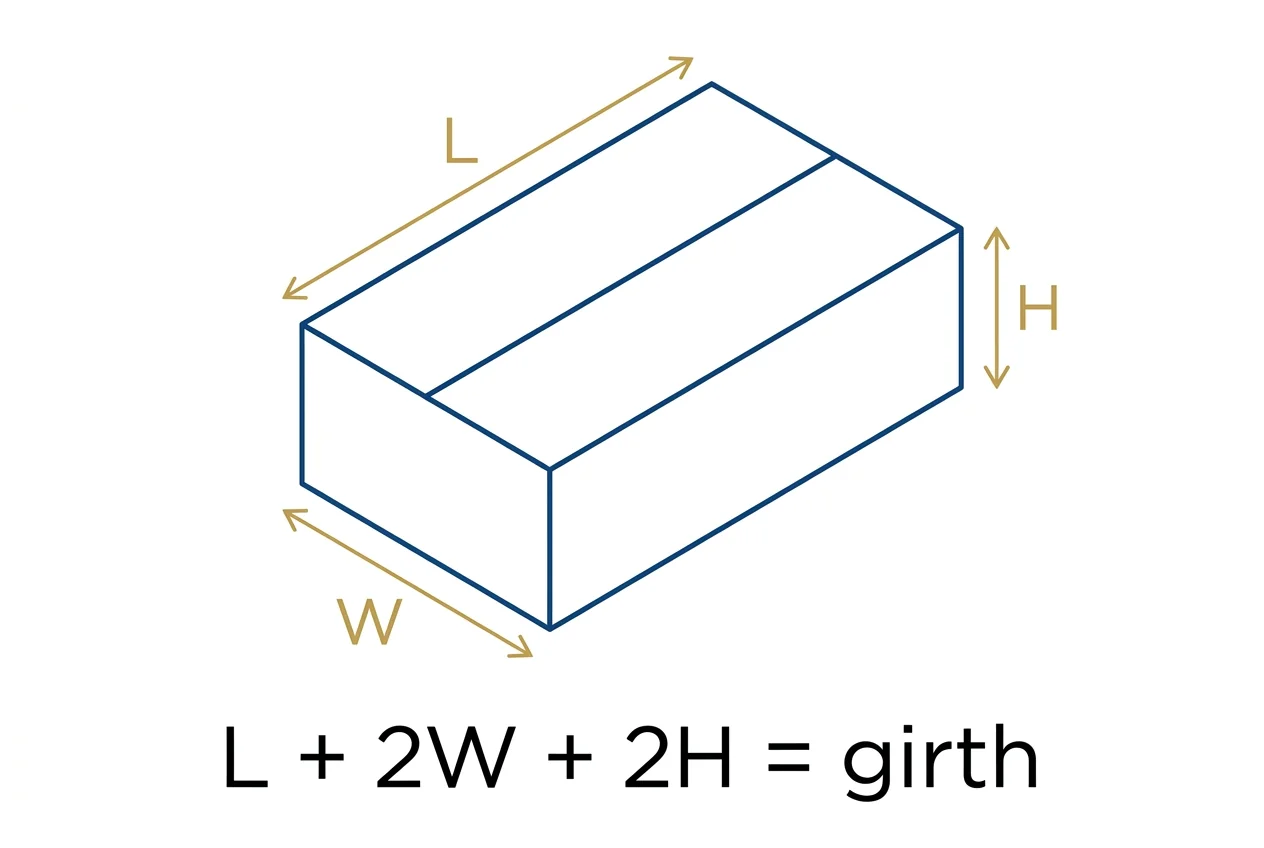
Carriers don't just measure the longest side of a parcel; they measure the longest side plus the perimeter of the other two. The reason is practical — a 200 cm long but 40 × 40 cm thick tube takes up the same space on an aircraft pallet as a much heavier parcel, so they bill on the envelope, not just on length.
L + (2 × W) + (2 × H), where L is the longest side, W and
H are the two shorter sides. Result must be ≤ 274 cm for the international parcel tier.
Worked example
A long rolled drawing tube measures 200 × 40 × 40 cm. Run the formula:
- L = 200 cm
- 2W = 2 × 40 = 80 cm
- 2H = 2 × 40 = 80 cm
- L + G = 200 + 80 + 80 = 360 cm
Maximum weight per piece: 68 kg
A single ICP piece can weigh up to 68 kg. That is essentially the top of what international carriers accept as one piece on the express-parcel tier, and it is the same cap our online quote engine uses — so the quote you see is the price you pay. Above 68 kg per piece the shipment is moved from "express parcel" handling to "freight" handling, which uses different rates, longer transit windows, different documentation, and different liability terms.
There is no limit on the number of pieces on a single Interdoc shipment, so a heavier consignment is best split into several cartons of 68 kg or less. Genuinely heavy single pieces above 68 kg can still move on the carrier network — they just need a manual freight quote.
Edge cases
Below 18 × 10 × 5 cm
Tiny parcels (jewellery boxes, USB drives, single keys) get lost in the network's sorting belts. Pack small items inside a larger carton with cushioning. The chargeable rate is the same; the survival rate is much higher.
Above 120 cm any side
Tubes, drawings, fishing rods, golf clubs. Often these still fit the length-plus-girth envelope, but check both rules. Anything over 274 cm L+G needs freight handling.
Above 68 kg single piece
Move to freight quote. Multi-piece shipments are fine — several 60 kg cartons on one waybill is straightforward. The 68 kg limit is per piece, not per shipment.
Above 274 cm L+G
Refused on the standard tier. Either repack into smaller cartons, or contact us for a freight quote where dimensional weight caps apply differently.
Many cartons, one shipment
Each carton must independently meet the per-piece limits. There is no cap on the number of cartons on a single Interdoc shipment. The quote engine treats each carton as its own line item for volumetric billing.
Glass, ceramics, electronics
The size limits do not change for fragile goods, but our liability for damage to certain fragile categories is limited — see the liability page. Pack defensively and consider declared-value cover.
Quick check before you book
- Is the carton at least 18 cm long, 10 cm wide and 5 cm deep?
- Is the longest side 120 cm or less?
- Calculate
L + 2W + 2H— is it 274 cm or less? - Is the actual weight 68 kg or less?
- Calculate volumetric weight:
L × W × H ÷ 5 000— is it 68 kg or less? - The chargeable weight is the higher of (4) and (5).
Frequently asked questions
What is the maximum weight Interdoc accepts for one parcel?
What is the maximum length plus girth?
How do I calculate length plus girth?
What is the smallest parcel size Interdoc accepts?
What happens if my parcel exceeds the limits?
Sources & attributions
Factual content on this page is compiled from the upstream sources listed below. The length-plus-girth formula and the per-piece envelope conventions follow the canonical industry standard used universally by air-cargo and parcel-courier carriers worldwide — there are no proprietary alternatives.
Primary upstream sources
- IATA Cargo Handling Manual — per-piece weight and dimensional envelope thresholds
- ICAO Annex 17 & Annex 18 — air cargo dimensional limits
- Carrier-network common envelope conventions — most-conservative-baseline approach across our partner network
Industry standards & terminology
- Length + 2(Width) + 2(Height) — universal length-plus-girth formula
- Rectangular envelope assumption used by automated sorting belts
- Round-up-to-next-cm measurement convention
- Per-piece (not per-shipment) weight cap convention
All original prose, analysis, examples and commentary on this page is the original work of Interdoc and has been verified against publicly indexed web content as not derived from any specific carrier's documentation.